
Toledo, OH

Over $10M in signed contracts from digital leads.
We rebuilt the account measurement first: one search hub per market, scripted problem-first social, every inbound call classified, and signed revenue attributed back by channel out of their own CRM.
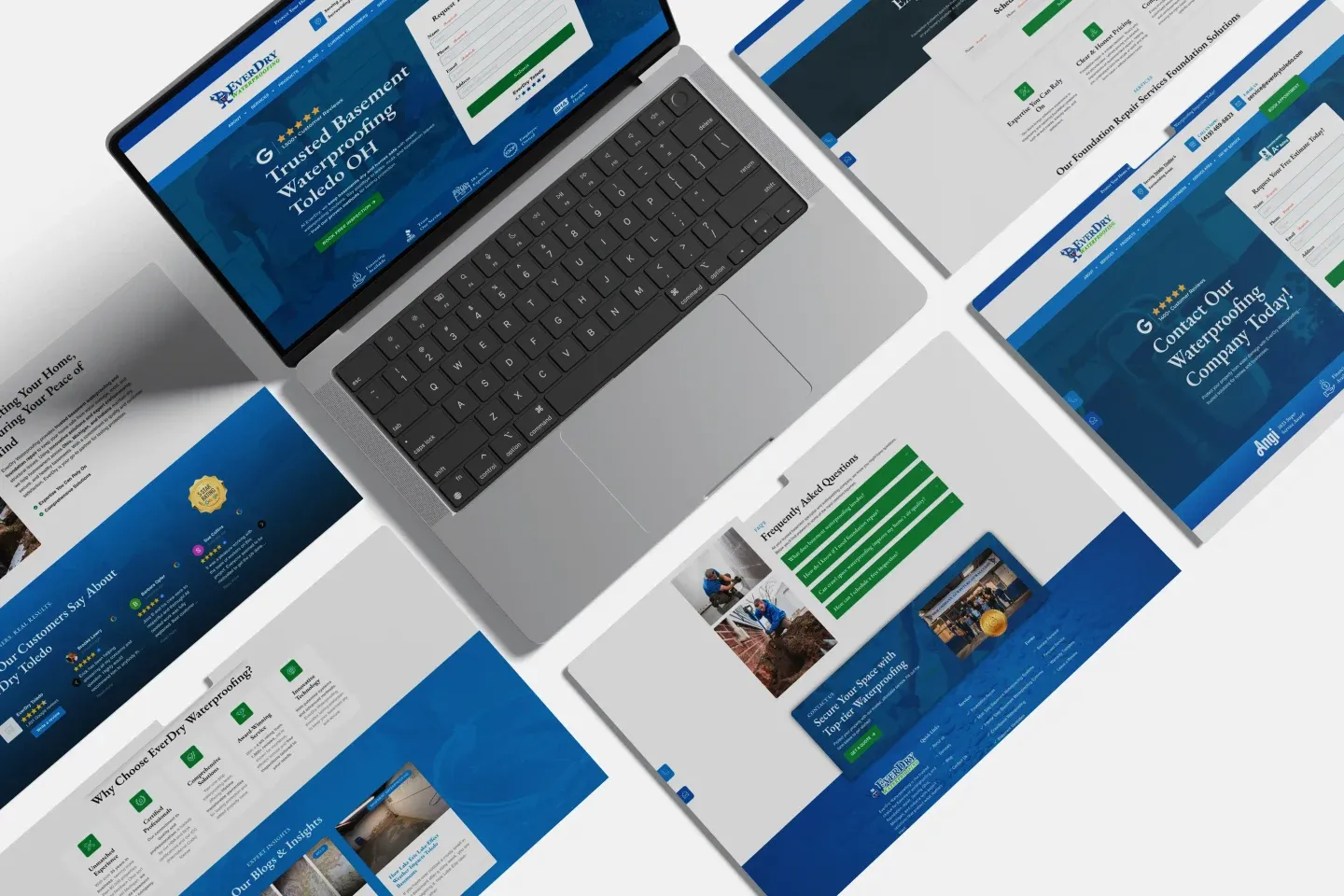
Engagement to date
What the rebuild produced.
$10M+
In signed contracts from digital leads, counted at signature from the client's own sales records.−37%
Blended cost per lead, from about $110 to about $70, on roughly double the media investment.1,200+
Digital leads generated, reported from the client's own lead records rather than platform conversions.Two of those four markets did not exist on the account when we took it over. Revenue and close rates come out of EverDry's CRM, not out of a platform's modelled conversions, which is the only reason a number like the first one is worth printing.
The challenge
A spend ceiling, expensive leads, and no way to tie a dollar to a job.
EverDry sells a considered, high-ticket home improvement service, and every sale requires an in-home appointment. That business model punishes the usual home services playbook, because volume of "leads" means nothing on its own. What matters is how many homeowners sit for an appointment, and how many of those appointments become signed contracts.
When the company engaged Localizr in April 2025, its advertising was doing the opposite of that. Three problems compounded each other — and the business was weeks away from opening two new markets on top of them.
A single catch-all campaign structure meant every market, every service and every level of intent competed for the same budget at the same bids. Search sat at roughly $7,000 to $12,000 a month, and any budget increase raised costs instead of volume. The account had effectively capped itself: more money bought the same demand at a higher price.
Creative was generic and static, with nothing built for the way a homeowner actually notices a basement problem — after a heavy rain, a smell that will not clear, a wall crack that got longer this year. Ads that do not name the moment do not get recognized in it.
No channel could be judged on revenue, only on volume. Inbound calls arrived on a single number with no source attribution and no classification, so service calls, job applicants and vendor calls were all counted as "leads" — a number that could never be reconciled with the sales board.
The business was preparing to open two new markets. Expanding an unmeasured account into new geography is how home services companies quietly lose a year of budget: the spend shows up immediately, and the evidence of whether it worked never does.
The strategy
Measurement first, scale second.
Budget did not move until the account could report a signed contract by channel. Five pieces, in the order they were built.
Step 1
Rebuild paid search around geographic hubs
The catch-all structure was replaced with dedicated search hubs, one per market: Toledo, Findlay, Fort Wayne and Mansfield. Each hub carries its own budget, bids, negative keyword list, ad copy and tracking number, so a market can be scaled or paused without disturbing the others. Brand campaigns were separated at the county level, because branded demand behaves nothing like generic demand and should never share a budget with it.
Step 2
Rebuild Facebook around scripted, problem-first video
Paid social was rebuilt as a scripted creative program rather than a set of image ads. The hook is written first, performed by recognizable local faces in real basements, and cut into variants around a single problem — so the account learns which problem moves a market, not which image performed.
Step 3
Measure the business, not the platform
Every channel and market got its own tracking number. Every inbound call is transcribed and classified. Leads, appointments and signed contracts flow back into one reporting layer, so a channel is judged on booked revenue and close rate instead of form fills.
Step 4
Earn the demand we were renting
Paid search buys demand; organic search keeps it. Near-identical city pages were consolidated into a hub-and-spoke structure where every market and every service has one strong page to rank instead of several weak ones competing with each other, on a single clean URL scheme with redirects mapped so ranking equity carried over.
Step 5
Scale deliberately
Only after measurement was live did spend increase, hub by hub, with each market proving out before the next increase. That sequence is the whole reason efficiency improved while the budget grew.
What breaking the ceiling looked like
Same eight months, one year apart.
January through August 2025 against January through August 2026, in the paid search account.
Before the rebuild
Jan–Aug 2025
- Campaign structure
- One catch-all campaign for every market, service and level of intent
- Monthly search investment
- About $8,000, and capped
- Adding budget
- Raised costs instead of volume, so the account bid up demand it already had
- Cost per conversion
- Held the ceiling in place: efficiency got worse as spend rose
- Average cost per click
- Branded and non-brand demand bidding against each other in the same auctions
- Reach
- Paying more for the same traffic
- Opening a new market
- Budget flows to whichever market converts cheapest today, so the new one never gets a fair trial
 Rebuilt on hubs
Jan–Aug 2026
- Campaign structure
- One search hub per market, with brand separated at the county level
- Monthly search investment
- About $35,000 at current run rate
- Adding budget
- Search investment up 3.2× year over year, with conversions up 3.3× alongside it
- Cost per conversion
- Down 5% while investment more than tripled
- Average cost per click
- Down 8% year over year, and down 15% through the peak season months
- Reach
- Clicks up 3.4× and impressions up 5.4×, a materially larger share of in-market homeowners
- Opening a new market
- Its own hub, its own budget, and its own cost per lead from week one
Paid social
Creative is a script problem, not a design problem.
1
Write the hook first
Every video opens on the homeowner's own experience inside the first two seconds — the sound of heavy rain, a damp basement smell, the crack that got longer this year. The brand comes after. The hook is written first and the rest of the script is built to justify it.
2
Cast a familiar face
Scripts are performed by recognizable local spokespeople in UGC style, filmed in real basements, phone-shot and unpolished on purpose, so the ad reads as a neighbor's warning rather than a commercial.
3
One script, several angles
Each concept is written into variants around a single problem: seasonal water intrusion, mold and air quality, foundation aging, financing and affordability, and customer testimonials. That way we find which problem moves a market, not just which image performed.
4
Re-cut it per market
Scripts are re-cut for each hub with local references and local landing destinations, so every market gets creative that sounds like it was made there.
5
Rotate on the season
Rain-season scripts are pushed hard through the wet months and swapped as they fatigue, measured on frequency and rising cost per lead rather than on gut feel.
Creative in market
Two live ads, vertical 9:16, shot on site.
Toledo, OH
Get your free EverDry inspection.
Measurement
Measure the business, not the platform.
Call tracking by source and market
Every channel and every market runs its own tracking number, so a call is attributed to the campaign that produced it rather than to one shared line that explains nothing.
AI call classification
Every inbound call is transcribed and categorized. Only about one in five turned out to be a new sales opportunity; the rest were existing-customer service, administrative and employment calls.
Revenue attribution through the CRM
Leads, appointments and signed contracts flow back into one reporting layer, so each channel is judged on booked revenue and close rate instead of on form fills.
What the call data actually showed
Four out of five "leads" were not leads.
Once every call was transcribed and classified, roughly 80% of inbound volume turned out to be service calls, job applicants and vendors. Any agency reporting that 80% as leads is reporting a number that cannot be reconciled with the client's sales board — and a cost per lead built on it can be improved without improving the business at all.
Organic and AI search
Paid buys the homeowner ready today. Organic reaches the one still diagnosing.
The organic side was rebuilt on the same logic as the paid side, over the same period.
On top of the hub-and-spoke architecture sits content built to be quoted: problem-first articles and comparison pages that answer the exact questions homeowners search after they notice a basement problem — where a sump pump should drain, why a basement carpet is wet after heavy rain, how to seal a window well, sump pump versus french drain — each structured with FAQ markup and linked into the service pages the account wants to move.
Those same articles are increasingly cited as the reference in AI-generated answers for basement waterproofing questions, a visibility channel most home services contractors cannot see at all. Total organic click volume is roughly flat year over year, because AI answers now resolve many informational searches on the results page itself. So the position to hold is being the source those answers quote.
Position 34 → 14
Average organic position year over year, from roughly the fourth page of results to the second.
CTR up by a third
Click-through rate rose by more than a third over the same window, on the same flat click volume.
Page 1 for the head term
The site ranks on the first page for basement waterproofing, owns its branded queries outright, and holds top-ten positions for the problem questions homeowners search.
Why the number matters
The important number is not the 37%. It is the 37% on double the spend.
Efficiency almost always degrades as budget increases, because the cheapest demand gets bought first. Cutting cost per lead while doubling investment means the account was not efficient before. It was small.
Digital closes at twice the rate
Digital leads close at roughly twice the rate of canvassed leads, which is only knowable because closed sales are reported back by channel.
The smallest channel carried the most valuable work
Paid social produced the fewest leads of the digital channels and signed the highest-value jobs. Optimizing on lead count would have cut it.
Branded search protects the base
Branded queries convert several times better than generic service terms, so brand coverage is defended first and non-brand demand is bought around it, market by market.
What transfers
Three lessons that apply to any high-ticket in-home service.
Basement waterproofing, foundation repair, roofing, HVAC replacement, windows: the structure and the measurement transfer between markets. Budgets and creative do not.
A lead is not a unit of value
Until calls are classified and sales are attributed, cost per lead is a number that can be improved without improving the business.
Structure decides whether budget can grow
Markets, brand terms and service lines need separate budgets, or a spend ceiling is inevitable and a new market never gets its fair share.
Creative is a script problem
On paid social, the hook and the story decide whether a homeowner recognizes their own basement in the ad. Design does not.
Questions about this engagement.
How long did it take to see results?
Lead volume improved within the first year of the engagement. The step change in scale and efficiency came once call classification, revenue attribution and the hub structure were all live. The account then absorbed several times the monthly budget at a lower cost per lead.
Did cost per lead drop because spend was cut?
No. Media investment roughly doubled over the compared windows while blended cost per lead fell about 37%. That is the point of the number: efficiency normally degrades as budget grows.
Did organic traffic grow too, or just paid?
Both, in different ways. On the organic side the average position improved from roughly the fourth page of results to the second and click-through rate rose by more than a third, and the site now ranks on the first page for the term basement waterproofing. Total organic click volume is roughly flat year over year, because AI-generated answers now resolve many informational searches without a click; the play there is to be the source those answers cite, which the brand pages increasingly are. Revenue in this case study is attributed to paid media through the CRM; the organic gains are reported as search visibility, not as signed contracts.
How do you show up in ChatGPT and other AI answers?
The comparison and problem-first content is structured so AI assistants can quote it directly, with clear questions, direct answers and FAQ markup. As a result the brand pages are cited as a reference in AI-generated answers for basement waterproofing questions, a visibility channel most contractors in the category are not yet measuring.
Is this revenue attributed by the agency or by the client?
Revenue and close rates come from EverDry's own CRM and lead reports, not from platform-modelled conversions. That is why the contract figure is quotable at all.
Do you work with other basement waterproofing companies?
Localizr manages paid search, paid social and SEO for waterproofing and foundation repair contractors across the Midwest. Structure and measurement transfer between markets; budgets and creative do not.
Book a Call



Want this run on your account and your markets?
20 minutes, straight to your market
We audit your accounts before you sign
A plan and a clear number, no pitch deck
Home services companies across Ohio, Michigan, Indiana, Wisconsin, Pennsylvania, and South Florida.